Polymer Sustainability and Recycling: Schemes for Enhanced Educational Content and Engagement
B. J. Love, Depts of Materials Science and Engineering (MSE) and Biomedical Engineering (BME)
Macromolecular Science and Engineering program (MACRO), The Univeristy of Michigan
Key Points:
- Polymer education is expanding beyond synthesis to address degradation, recycling, reuse, design lifetimes, and the full end-of-life value chain.
- Technical science meets real-world economics: Students explored mechanical, chemical, and biological recycling, degradation kinetics, characterization tools, and the costs and feasibility of recycling operations.
- Games and case studies drove engagement: Hands-on game development and real-world recycling scenarios increased participation, attendance, collaboration, and interest in polymer sustainability.
Abstract: An inaugural graduate level engineering class was taught at the University of Michigan in winter term 2026 tied to polymer sustainability and recycling. The rationale for this class was based the growing sense that the typical polymer curriculum is based on synthesizing unique forms that satisfy many specific design requirements. To dedicated so much of the education content to polymer structural discovery and control, scale-up and construction, relative to design lifetimes, and the real cradle to grave costs for materials selection seems incomplete. The 16-student cohort that took this sustainability course represented typical disciplines (e.g. Materials, Macromolecular Science, Chemistry) but also included students from Environmental and Mechanical Engineering. The syllabus included technical elements of polymer breakdown by various modes, surveys of characterization methods including viscosity, chromatography, bond assessments for new chemistries forming and kinetic models for breakdown. What distinguished this class was the use of demonstration games. As preparation, we acquired and played several available educational games on the recycling enterprise, and students critiquing them for what isn’t included. From that baseline, we constructed and played several new games, based on what we learned in class. Included here details about how didactic hours were spent in class and highlights about the case studies, game development, and pedagogical insights on arousing interest in class.
1.0. Introduction: The need to expand polymer education to include design lifetimes and end use is crucial as the world is digesting the reality that 100s of millions of tonnes of polymers are produced annually1, and large fractions of what is produced is either landfilled, a challenge to recycle, or more expensive to reuse than virgin polymer product2,3. Let’s face it. We have been working for the last 50 years to optimize curricula to consider how to make polymers4,5, considering raw material cost, synthetic complexity, and rates of synthesis, processing, and statistical process control producing polymers that are structurally invariant day to day in commercially viable ways. Regrinding/remolding formed polymers are essentially studies in how reprocessing polymers change chain length, structure, viscosity, and reactivity. Polymers collected at materials recycling facilities (MRFs) risk cross contamination of other polymers passing through resulting in recycled products are either expensive and pure or cheaper with impurities, impacting blending and copolymerization6–10. There are dynamic changes in polymer structure strictly linked with additives that are also formulated into resins including light stabilizers, antioxidants, colorizing agents and dyes, fillers, plasticizers, reactive diluents, and processing aids, many of which can affect the end properties of recycled products if not also controlled6,7,11. Our own research has been considering how to toggle between polymeric forms due to changes in electronic structure12–14 through reversible bonding for some time and displacing common polymers using ionic liquids to extract biopolymers from agricultural biomass discards.15–17
As specific technical challenges have been solved, there has been growing evidence in the last 10 years that polymer products will also have some form of formal design lifetime in many products and there is a need to consider what is the end of use plan beyond the landfill18,19. Figure 1 shows the rise in interest tied to polymer sustainability and design lifetimes.
The need to create educational content focused on the science and engineering of breakdown strategies in polymers is clear. Course content can be centered on paths for mechanical, chemical and biological recycling, leveraging temperature, tools, and chemistries whether based on enzymes, light, or other chemical moieties that can reduce strength, molecular weight, and mass over their own time scales. There is a wealth of historical content on the mechanisms of acid and based catalyzed glycolysis used to break down commercial polyesters such as PLA and PGA used as biodegradable sutures in medicine, and in efforts to break down PET down to monomers that can be repolymerized into new forms. Here, content can be expanded on reaction pathways, mechanisms analytic techniques tracking changes in chain length, and the development of kinetic models to resolve the rates of deterioration and overall rates of conversion. Emphasizing these technical aspects of chain breakdown seems to suggest that polymer reduction is possible under a range of conditions. Most of what has been mentioned addresses the question about what is possible. Evaluations are also needed to ensure that energy and cost investments being made in breaking down structures are not prohibitive.
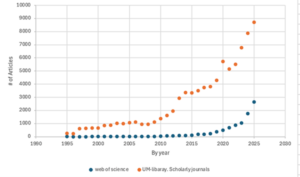
FIGURE 1: The number of citations/year using the keywords “polymer sustainability” in both the Web of Science and in the University for Michigan Library.
There are separate issues on how to convey content. Many technical classes are lecture/recitations. For graduate content in polymer sustainability, creating a new lecture class puts more onus on the instructor to find/curate this content. That makes the students more passive sitting in the class absorbing content. If we are thinking about new courses, time spent thinking about hot to deliver that would also be useful. Constructive use of the dead time between periods is a useful way to set the tone as preparation for a classroom experience, to create collaboration between students and the instructional staff, and to establish context coinciding with course content20. This was also shown in clips of Robert Reich’s classes before class started from the recent film The Last Class21. There wasn’t a large enough playlist of songs dealing with “recycling”, but there were enough to at set a tone and to get most students to their seats before class began.
Giving the short time between deciding on a class like this and the start of the term, I chose to use more forum-based graduate learning and mission-oriented game-based design and case studies to highlight features of recycling and sustainability. The details of class organization and its outcomes follow here.
2.0. Materials and Methods tied to course content: The course was in a lecture hall, meeting twice/week 3:00-4:20PM synchronously. There was no option remote access for students except for the occasional days when we had industrial presenters from off campus. The room was configured with longer tables in front to allow for group interaction. The Univeristy of Michigan regularly records lectures making them available to students afterwards so students missing lectures could observe content post-class. The learning course management platform used Canvas®, and commonly a few supporting slides along with supporting content (papers, articles, links) were included with 1 module tied to each lecture. Assignments and the 1 mid-term exam were shared electronically through Canvas, online submissions. I graded assignments and exams.
2.1. Syllabus: The course was broken up into technical content and performative content. The technical content focused on how finished polymers forms could be returned to smaller building blocks or fragments and the processes required to achieve that. For many condensation polymers that is already known in terms acid- and base-catalyzed hydrolysis that break esters, amides, etc., and yield smaller chains with lower strength. There are other schemes using cryogenic milling, rapid cutting operations, enzymes, bacteria, penetrating radiation, and oxidizing atmospheres that can also break chains but in less controlled fashion can also trigger crosslinking as well. There is a need to track changes in molecular weight, chain length, strength and stiffness through all these mechanisms.
Table 1: Thematic content
Area Weighting
Technical Content:
Breakdown strategies: (Mechanical/Chemical/Biological, photo) 20%
Tools for probing degradation (Spectroscopy, viscosity, GPC, mechanical) 20%
Kinetics of Degradation: Linked with time, rates, energies, cost: 20%
Performative Content
Case Studies (3) 20%
Game development: 20%
Much like we used tools to measure progress in polymerization, we used those same tools to track the opposite depolymerization routes happening. If chains shorten with depolymerization, resin viscosity should also go down. Similarly, chromatography can be used noting that longer retention times are seen with depolymerization given that smaller chains can percolate more easily into the pores of the GPC column.
The most important data analysis is the kinetic analysis, linking the schemes for depolymerization and processing directly with changes in molecular weight, and presenting these both in terms of kinetic rate constants, and if the energy required to elicit such a change is understood, now there is a rendering of the cost required to break down a specific polymer chain. It’s conceivable that undertaking these kinetic experiments at different temperatures might yield different rate constants and the efficiency of the depolymerization can change, all under the guise of an Arrhenius type analysis as well.
2.1: Case Studies. All of what is mentioned previously is commonly found in a technical class. The performative content is different. Here case studies consider not only the local grinding, irradiating, or exposing the polymer to a bacterium, but there are separate needs to collect, wash, sort, isolate and purify, and transport polymer products to the rendering facility. There is a need to do this efficiently to not needlessly make the product more expensive. 3 different case studies were developed, one tied to polyurethane foam grinding and repurposing from mattress collections collaborating with a start-up with IP tied to rendering, a second tied to understanding the value proposition of a company rendering running shoes at scale in the Nederlands already. The questions posed to students were whether the same kind of scaling was possible in the US and where? The third case study considered the use of wholesale operators to collect, stockpile and redirect packaging materials back to their suppliers negating the need to remold the packaging to specification. Damaged packaging could be discarded and there would be a need for larger quality control, cleaning, and assessment of what went back to the wholesalers, but the notion of not grinding, thermally processing, and degrading the material was compelling. Students were asked specific prompts about size and locations of operations, costs of enterprises, and to guesstimate the price of recycled products with the idea of what kinds of subsidies would be needed to gain the interest of others to fuel this.
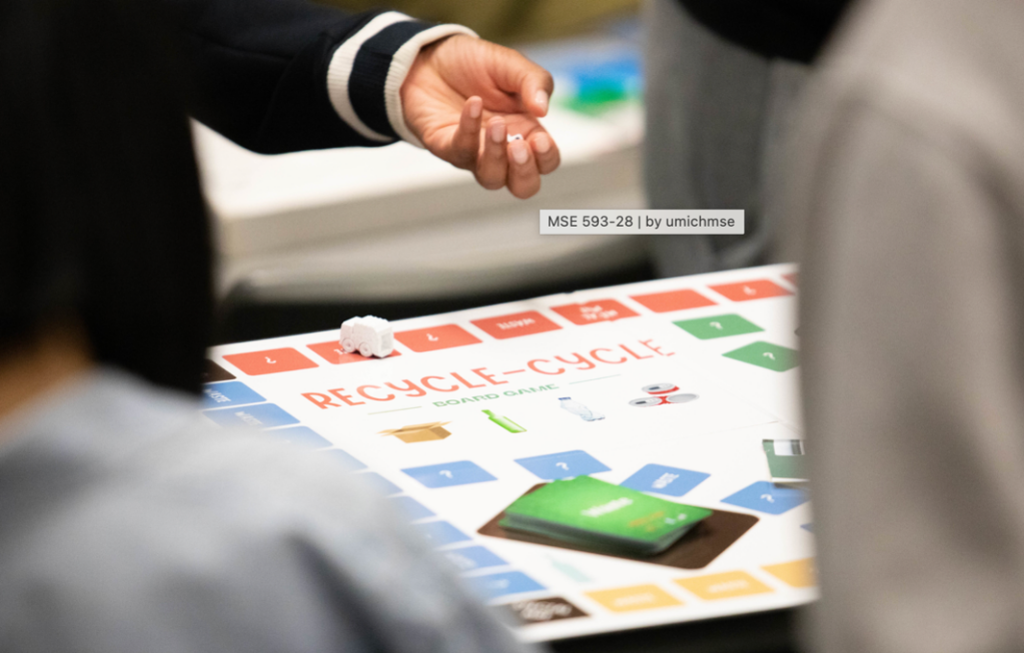
2.2: Game Development The other performative piece was game development that conveyed throughout the term. During week 1, students played 2 boardgames that were acquired before the start of the term to allow them some sense of what games already existed. Video game examples were also presented online. Students met in groups and discussed strengths and criticisms about the games they played and had seen. From there, time was set aside every other week during the term for the teams to either identify tasks, work on game goals for new game ideas, meet with staff on intellectual property tied to game development, and to understand the logistics and lead times to create prototype games with game board developers. The last class period was set aside for the teams to come back together to play the class developed games and to compare whether the new games addressed any deficiencies from the games that had been originally acquired.
2.3: Setting the tone for class: There is nominally 10 minutes between the end of the previous hours class and the start of the next class period. Normally this time is a dead time when students and instructional staff shuffle between rooms. If there is no class before the assigned class period, one can set up early. I found that the class ending before us commonly left the room 5 minutes early allowing me to set up a musical feed before class started. A playlist of 20+ songs (10 had some form of environmental theme) that were less than 10 minutes long was created that could be fed through the internal microphone system in the room. The idea was to let students simply listen as they were coming into the room. There was no explanation for the music.
3.0 Results and Discussion:
3.1. General observations: First, as a general assessment, one must look at features of classroom engagement in addition to students mastering content. Michigan has a lecture capture system that allows for lecture recording and playback remotely. Michigan also has 3 campuses and students could be on any campus before coming to class, either by bus, or driving and parking etc. So, there are larger logistical impediments to get students to class. Attendance was neither recorded nor graded.
Class attendance was estimated at ~80%. Some students missed for excused and planned absences and that is included in the missing fraction. But in general, this attendance was quite high for both a graduate level class and for one that did not have some required attendance element such as a laboratory exercise. The general takeaway was that students were in class because they wanted to be there although the game development elements required team engagement whether students were in class or not. There was a sense that being there was better than watching the video capture afterwards.
3.2 Typical technical content covered as part of a polymer sustainability course: Content was presented tied to mechanical, chemical and biological recycling phenomena. Mechanical recycling focused on correlations that exist between each successive immersions in the grinder and extruder and its impact on melt flow (usually higher flow and lower viscosity) and on the final extruded product in terms of mechanical properties. In class, there was a focus on commodity and high-volume polymers given that are higher volume products. There was also content when grinding or shear rates were sufficiently slow such that polymer was being cut but with no change in polymer chain length. To achieve high throughput, usually higher shear rates are used so most grinding, and extrusion operations tend to reduce molecular weight both of virgin and reground polymer.
In chemically recycled polymers, there are ample examples of condensation polymers that hydrolyze, but the notion to break down polymers to monomers whether based on C-C or other bonds tends to take a long time making them technical achievements and commercial failures. There were long discussions in class about how much breakdown was enough to warrant useful for a second life. Also coupled to these discussions were questions about where chemical degradation was happening. If hydrolysis happened quiescently in the environment, there are questions about the fate and transport and latent toxicity of those by-products. The larger take-away was that the schemes for performing chemical breakdown might be more easily achieved and with the higher vapor pressure of the reaction byproducts, they are more likely to be captured and reusable in more common petrochemical al processing operations where refining already is taking place. Thus, where chemical recycling happens might matter too!
Biological and photochemical breakdown of polymers are really subsets of chemical breakdown where either radiation or enzymes expressed by the resident fungi or bacteria can perform the digestion. There is tremendous interest in enzymatic breakdown of recalcitrant C-C bonds and there appear to be ensembles or consortia of fungi including laccases that appear symbiotically to breakdown polyolefins. We probed the current research, and it appears that LDPE with lower crystallinity is more susceptible to biological breakdown, as are lower molecular weight chains, and thin film specimens that present a large surface area/volume ratio resulting in bulk penetration.
3.3: Tools for probing chain length: We know that colligative properties depend on the number of molecules in solution, so assuming that polymers are soluble in some form of solvent, osmotic pressure determinations, intrinsic viscosity and melt viscosity determinations, bond assessments whether by NMR or by IR and other structural determinations, particularly for semicrystalline polymers like PE, PP, and nylon are useful.
Polyolefins are quite difficult to dissolve in common solvents and so often hot-GPC is run to analyze these structures. There was discussion about the nuances of these different techniques and that crosslinked structures don’t dissolve and thus, it’s impossible to measure changes in chain dynamics. Sometimes there are observational inferences about oxidation occurring but it’s difficult to assign a single mechanism that is clear about where on the chain is degrading. There is a need for more potent tools of analysis.
3.4: Kinetics: There are plenty of kinetic models to describe how molecular weight changes with time usually under a variety of experimental conditions. Several kinetic models were presented mainly to consider where along a chain might be more susceptible to fracture. Chains that unzipper from one end are more likely to maintain one long chain for a longer time in solution suggesting one kind of model, while chains that fracture in the middle of a chain, tend to have a faster kinetic decline in molecular weight.
Tied to all the technical aspects of the class, there is often a compelling reason to go deeper and focus only on technical achievement. To focus on the fact that there is some framework of success in breaking down these structures, and that there is some rate of change of these processes, and that takes both time and money depending on the tools and environments being used. It seems richer to consider whether certain pathways are more feasible or simply easier to consider. Hence, this was our interest in delving deeper into specific case studies where both recycling and reuse might be undertaken.
3.5. Case studies: The case studies were included as business propositions to help value the relative cost of recycled products. In each case, there was a known, incoming material stream separate from what typically arrives from a Materials Recycling Facility as a compressed pallet. Our students took roles as entrepreneurs involved in reducing these incoming forms of discarded polymers (Case 1: polyurethane foam, Case 2: multiple materials including Polyurethane, EVA, nylon, and case 3: high density polyethylene).
In each instance, process locations were generally sighted, and transportation costs were estimated for moving raw products where mechanical recycling could happen. Assumptions were made about the cost of energy, prices of fuel and rent, labor costs, material throughputs, etc. The larger question was based on rough guesstimates for these, what would be the cost per pound of these recycled products and tool investments in this recycling plant. If the process costs ultimately proved higher for recycled HDPE than raw HDPE for example, this might require some form of subsidy to justify users willing to use recycled products over virgin material. The students were asked to critique their assumptions and to consider how to make the prospect more appealing…
3.6. Game development Six class periods interspersed over the term (20% of the didactic hours) was dedicated for game development. Here the focus was on existing game assessment, new game ideation and simulation, prototyping and scenario assessments, and developing general game rules and objectives. Near the end of the term, there was need to work outside of class on artwork and on uploading content with online game developers to have product arriving by the last day of class which was tested and compared to the original games we had surveyed. The class broke up into two groups of 7-8 to complete all the tasks tied to game board or card development, scenario planning, player actions, prototyping of game pieces, and the construction of game rules that could convey with the game hardware. We used boardgamesmaker.com as our vendor and with expedited delivery of games, received games in 1 week from our uploading of all content. Example pictures of the games in use are shown in composite form in Figure 2.
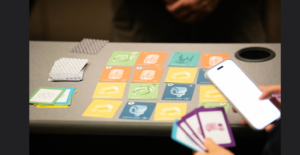
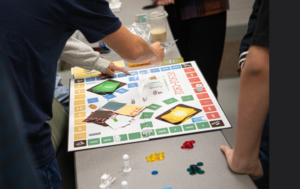
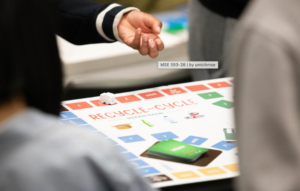
Figure 2: Composite photographs of the students playing their games in class. One game was a boardgame with 3-d printed tokens printed by the students and the other was more of a card game with tokens.
In retrospect, and in discussions with the class, there was some feeling that the 2 large groups might have been too big to execute on the tasks for game development. We could have probably survived or thrived with groups of 4 or 5 and creating another game form from leveraging smaller groups might have been interesting as well. I originally thought the class to make one game so the move to two games was already an accommodation. There was a pretty large lift for game cards that had to be submitted individually to the web site.
There is a comfort level in performing transactions and exchanges like what goes on at the front end of the MRF. The real recycling occurs downstream from this and it’s difficult to both assimilate a complete picture of how this works, what are potential complications, and what are the implications if a recycle stream is contaminated, out of specification, etc. It does mean the stream is valueless, but there are needs to resolve how to value these complications that can arise and resolved. Ideally, with better sorting and isolation, maybe these events are less likely to occur. Putting those scenarios into the games proved difficult.
Students seemed generally proud of their work products including the games. There are more people could generally understand about the specifications for resins being processed from materials recycling facilities regarding composition, viscosity control, and thermal stability. It would be nice to think about how to add more technical features into future game scenarios beyond the more basic assessments of “cleaning”, “recycling”, and landfilling.
3.7. Intangibles: Arousing interest in class beyond the syllabus. Class started on Tuesday/Thursday at 3:00PM, but the room was vacant commonly from 2:45PM on each day. I made it a point to be on site by 2:45 each day using the microphone to amplify the songs into the room through the public address system equipped in each classroom. Music was played typically 6-8 minutes at low volume before class at 3:00. There were some students who came to class earlier simply to find out what was song for the day and for some early engagement with me before class. There were other students coming from other environs on campus who probably couldn’t get to class any earlier and missed out. But this was not a required piece of class and certainly had no effect on their grade.
4.0. Conclusions:
1.). The University of Michigan now has a course on the end of life for polymers and the recycling enterprise to bookend its existing synthesis courses on the front end. Technical content was included, but technoeconomic measures of recycling were used to put recycling in context.
2.). The use of game elements and case studies increased student activity and attendance. The anecdotal evidence was that this was a class to perform in and not lurk in remotely. The students seemed taken by the challenges and took pride in the products they produced as part of the class outcomes.
3.) The use of the time before class and reconsidering the physical space where class happens seem important to set the tone for class. These classes are not interchangeable elements fitting in any room, anywhere. Our neglect of the time before class is a loss for putting our students in a frame of mind conducive for class.
4.). The content is being repackaged into alternative formats adaptable for Societies, Institutes, and industrial interests focused on end of use in polymers. The program will reoffer this class given the initial success and the groundswell of support for didactic content on sustainability. Attempts are being made to raise the scale and impact to increase the number of potential registrants for the on-campus offerings.
Sources:
(1) Statistica. Total plastics production in the United States from 2010 to 2022. Market and consumer data: plastics production. https://www.statista.com/topics/7460/plastics-industry-in-the-us/.
(2) Greenpeace. New Greenpeace Report: Plastic Recycling Is a Dead-End Street—Year After Year, Plastic Recycling Declines Even as Plastic Waste Increases. Climate Claims Fall Flat Again. https://www.greenpeace.org/usa/news/new-greenpeace-report-plastic-recycling-is-a-dead-end-street-year-after-year-plastic-recycling-declines-even-as-plastic-waste-increases/.
(3) Chamas, A.; Moon, H.; Qiu, Y.; Tabussum, T.; Jang, J. H.; AbupOmas, M.; Scott, S. L.; Suh, S. Degradation Rates of Plastics in the Environment. ACS Sustain. Chem. Eng. 2020, 8 (9), 3494–3511. https://doi.org/https://doi.org/10.1021/acssuschemeng.9b06635.
(4) Economy, J. Polymers as an Integral Part of a Materials Science and Engineering Curriculum. Polym. Int. 1999, 48 (10), 941–943. https://doi.org/10.1002/(SICI)1097-0126(199910)48:10<941:AID-PI251>3.0.CO;2-3.
(5) Emrick, T. Dedication to Polymer Science & Engineering Research and Education at <scp>UMass</Scp> Amherst. Journal of Polymer Science 2024, 62 (16), 3595–3596. https://doi.org/10.1002/pol.20240538.
(6) Akhras, M. H.; Marschik, C.; Chung, C. N.; Traxler, I.; Kruta, K.; Kloiber, K.; Fischer, J. Assessment of Property Profile of Post‐industrial Polypropylene Recyclates through a Multivariable Recycling Process. J. Appl. Polym. Sci. 2024, 141 (31). https://doi.org/10.1002/app.55731.
(7) Mager, M.; Zeilerbauer, L.; Felgel-Farnholz, A.; Czaker, S.; Fischer, J.; Postema, S. H. J.; Kasper, J. B.; van Eijk, M. C. P. Advancing Mechanical Recycling of Polypropylene: Lessons from Sorting, Washing, and Life Cycle Assessment. Waste management (Elmsford) 2026, 212, 115356-. https://doi.org/10.1016/j.wasman.2026.115356.
(8) Ito, S.; Nagatani, A.; Watanabe, H. Early‐Stage Degradation and Stabilization of Polypropylene Under Simulated Mechanical Recycling: Assessment and Practical Indicators. J. Appl. Polym. Sci. 2026, 143 (6). https://doi.org/10.1002/app.58169.
(9) Caudle, B.; Nguyen, T. T. H.; Kataoka, S. Evaluation of Three Solvent-Based Recycling Pathways for Circular Polypropylene. Green Chem. 2025, 27 (6), 1667–1678. https://doi.org/10.1039/d4gc02646b.
(10) Traxler, I.; Laske, S.; Fischer, J. Closed-Loop Recycling of Polypropylene: A Case Study on Mechanical Recycling of Separately Collected Yogurt Cups in Austria. Resour. Conserv. Recycl. 2024, 205, 107537-. https://doi.org/10.1016/j.resconrec.2024.107537.
(11) El Darai, T.; Ter-Halle, A.; Blanzat, M.; Despras, G.; Sartor, V.; Bordeau, G.; Lattes, A.; Franceschi, S.; Cassel, S.; Chouini-Lalanne, N.; Perez, E.; Déjugnat, C.; Garrigues, J.-C. Chemical Recycling of Polyester Textile Wastes: Shifting towards Sustainability. Green Chem. 2024, 26 (12), 6857–6885. https://doi.org/10.1039/d4gc00911h.
(12) Trenor, S. R.; Long, T. E.; Love, B. J. Development of a Light-Deactivatable PSA via Photodimerization. Journal of Adhesion 2005, 81 (2). https://doi.org/10.1080/00218460590922011.
(13) Trenor, S. R.; Shultz, A. R.; Love, B. J.; Long, T. E. Coumarins in Polymers: From Light Harvesting to Photo-Cross-Linkable Tissue Scaffolds. Chem. Rev. 2004, 104 (6). https://doi.org/10.1021/cr030037c.
(14) Huyck, R. H.; Trenor, S. R.; Love, B. J.; Long, T. E. Photodimerization of Coumarin Functionalized Poly (Alkyl Acrylate) and Poly(Alkyl Methacrylate) Random Copolymers: Influence of Copolymer Composition on Photocrosslinking. Journal of Macromolecular Science, Part A: Pure and Applied Chemistry 2008, 45 (1). https://doi.org/10.1080/10601320701681839.
(15) Rieland, J. M.; Nikifshar, S.; Hu, Z.; Nejad, M.; Love, B. J. Ionic Liquid-Mediated Biopolymer Extraction From Coffee Fruit. Macromol. Mater. Eng. 2023, https://doi.org/10.1002/mame.202300145. https://doi.org/https://doi.org/10.1002/mame.202300145.
(16) Rieland, J. M.; Love, B. J. Ionic Liquids: A Milestone on the Pathway to Greener Recycling of Cellulose from Biomass. Resour. Conserv. Recycl. 2020, 155, 104678. https://doi.org/10.1016/j.resconrec.2019.104678.
(17) Lawal, T. D.; Rieland, J. M.; Love, B. J. Water Regulates Ionic Liquid Solvation and Can Fine-Tune the Rheological Behavior of Dissolved Cellulose. Results in engineering 2025, 28, 107550-. https://doi.org/10.1016/j.rineng.2025.107550.
(18) Wang, M.; Shi, S.; Li, F.; Hou, W.; Guo, H.; Wang, S.; Jia, H.; Dai, J. Efficient Recycling of Polyester and Microcrystalline Cellulose through One-Step Extraction from Waste Polyester-Cotton Blended Fabrics with Deep Eutectic Solvents. Chemical papers 2022, 76 (9), 5601–5612. https://doi.org/10.1007/s11696-022-02246-5.
(19) Edun, A.; Hachem-Vermette, C. Post-Consumer Waste Recycling for High Performance Building Envelopes in Cold Climates: Assessing Energy and Environmental Impacts. J. Clean. Prod. 2022, 372, 133686-. https://doi.org/10.1016/j.jclepro.2022.133686.
(20) Mowreader, A. Play that funky music: the case for music in the college classroom. https://www.insidehighered.com/news/student-success/academic-life/2023/02/08/three-reasons-professors-engage-students-music.
(21) Kirschner, E. Https://Www.Thelastclassfilm.Com; Abrorama: USA, 2025. https://www.thelastclassfilm.com (accessed 2026-05-11).